Do ESL or ELA Teachers need a degree in Linguistics?
An adult student was sharing his opinions with me about teachers’ qualifications; various TESL certificates and diplomas, past employment experience as an Examiner, years of experience in classrooms or online. We discussed whether or not a Linguistics master’s was a necessary requirement for ESL teachers and I decided to write this post to explain what TESL programs aim to do.
Good initial training programs equip teachers with a strong foundation in multiple domains:
i) knowledge areas: grammar, syntax, phonology, second language acquisition
ii) teaching the four skills of language: listening, reading, speaking and writing
iii) general teaching skills: learning objectives, lesson planning, course design, assessment, choosing or developing materials, classroom management, feedback on error, testing
As an example, here is the content of my year-long DTEFLA training program:
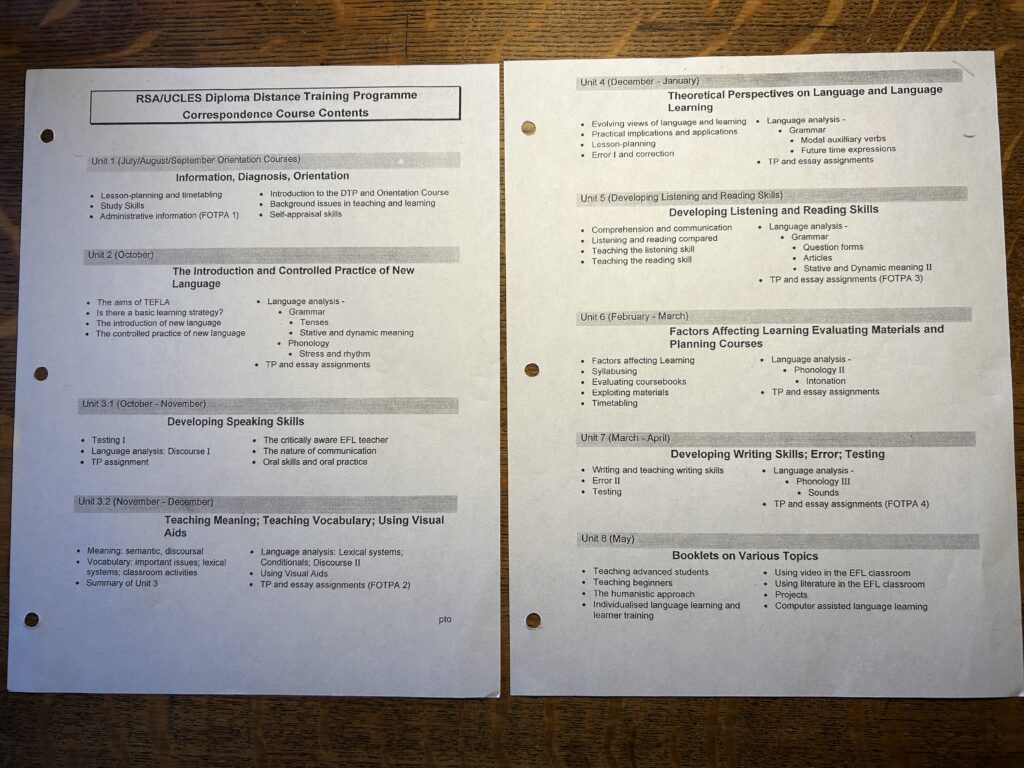
And here is the syllabus, and a letter from the Head Tutor attesting to the length of the course:
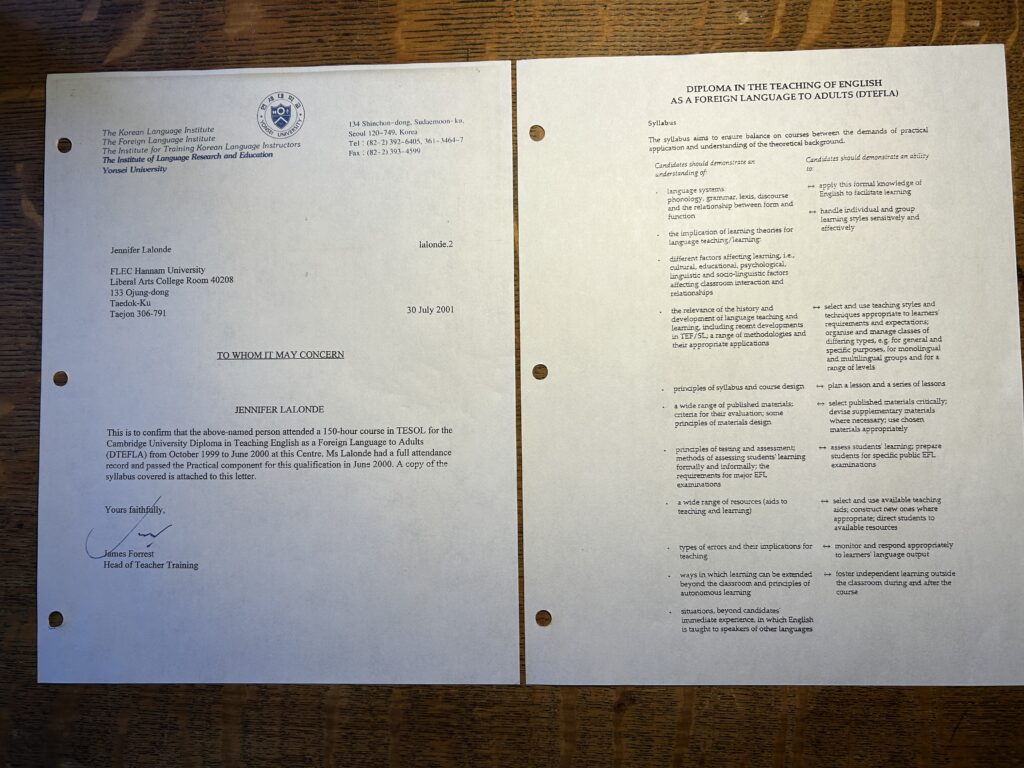
As you can see there was a year of study; my group of fellow trainees met every Saturday for input sessions. There was a reading list with about 30 recommended textbooks and we completed readings for each unit in preparation for lectures and discussions on Saturdays. Throughout the year, there were assignments and classroom observations. In order to earn the diploma, candidates had to pass the written exam: six essay questions in six hours over two days, which were sent to Cambridge for marking, and the practical teaching exam: two observed lessons by an Examiner from London, UK.
I passed the practical component on my first attempt but not the essay portion. I still recall the essay question I failed: explain my approach to teaching modal verbs at a variety of levels and in reference to two first language groups. Cambridge offers one additional attempt and so I studied over the following year in applied what I was learning in my lessons to university students and workers in the context of a continuing education program. A master’s in linguistics or teaching reading or phonology will test subject knowledge whereas TESL training programs prepare candidates to succeed in the classroom. The DTEFLA is a professional diploma that communicates to employers and students that a person can apply knowledge in planning and delivering instruction.
Most teachers, as time and budget permit, will continue learning through additional degrees or professional development. A master’s degree in core linguistics: phonology/phonetics, syntax or discourse analysis but reading the textbooks and keeping up with research works, too. In short, teacher preparation programs prepare people to succeed in a classroom. ESL draws on a lot of knowledge areas and the best teachers are lifelong learners, avid readers and critical and self-aware practitioners.
Is writing by hand important?
When I was doing my undergraduate degree at the University of Ottawa in the late 1990s, and when I went back to upgrade my GPA at Trent University in 2002, I took notes in class by hand, and submitted hand-written essays and assignments. I heard somewhere that people take notes when listening to a lecture as much to have large muscles in motion as to review them later on. When I did the final written examinations for my DipTEFLA, the three essays in three hours were written by hand. In some places, the IELTS writing section is still done by hand.
I developed the ability to touch type in my 30s but I do not write as fluently as I did when I was in my 20s, writing by hand. After a decade of teaching online and using social media and email, I felt an intuitive need to go back to writing as much as I can with paper and pencils. I have adult learners who don’t even own pens or notebooks and they report being productive, effective and happy. I believe children must learn to print and write in cursive in as part of their acquisition of language. I’ll be collecting articles on this interesting question on this page, as more research is done.
Recommended Reading for Parents
Here are some trust-worthy organizations that parents and teachers/tutors can rely on:
Reading Universe
Reading Rockets
British Council LearnEnglish Kids
tesol.org
https://www.iatefl.org/meet-iatefl-sigs/
Do advanced English learners need to learn grammar terminology: parts of speech, sentence components, grammatical concepts, syntax?
The answer is yes! There comes a time in your English acquisition journey that it makes sense to invest in learning language terminology, as many of you don’t know what an adverbial or predicate or complement is even in your first language. So it’s both – learning grammar words, and learning what their meanings. What terms do you need to recognize and get a firm grasp of? There is a checklist below. These checklists are phrased in ways that make sense to English learners, not other teachers.
Parts of Speech
Nouns and NPs
Verbs, verb chains, VPs
Adjective – regular and participal
Adverbs and adverbials
Preposition – movement and location
Conjunctions
Interjections
Pronouns – demonstrative, possessive, subject and object pronouns
Sentence Components
Subject
Predicate
Dynamic verbs – active and stative
Direct objects vs indirect objects
Linking verbs (also known as copular verbs)
Complements
Sentence, independent clause, dependent clause, phrase
Simple, compound, complex, compound-complex sentences
Concepts
Active vs passive voice – subject of the sentence vs doer of the action
Subject of a sentence vs subject and object of a verb
Tense vs aspect
Modality – grammatical modals and lexical modals
Gerunds vs infinitives
Transitive vs intransitive
Participles – verbal vs adjectival use
Syntax
NP (4 part NPs, gerunds, relative pronoun-lead clauses)
Determiners – articles, pronouns, quantifiers
4 part NPs – pre-modification can be adjectives or other nouns
4 part NPs – post-modification can be prepositional phrases, that- phrases, relative pronoun-lead clauses
embedded clauses & subordination
Movement rules – yes/no questions vs Wh- questions, helping verbs, negation
What learning objectives are achieved through study of videos & transcript?
Transcripts are rich with opportunities for learners to notice features of the target language; both through reading what’s written and by listening to what is spoken.
Videos provide dual input – the audio soundtrack as well as visual clues to meaning, both of which are complemented with a written transcript. With video running alongside audio, word and phrase meaning (bottom-up) as well as overall gist (top-down) can be more easily inferred when background knowledge and contextual hints when both ears and eyes are taking in information.
Podcasts, on the other hand, provide just the audio input. The benefit of audio-only is learners then have the opportunity to listen attentively to capture meaningful chunks before checking their understanding through comprehension checks, or with the transcript.
Unlike purely written word driven approaches, centering video clips is multi-sensory. I believe the intermediate plateau exists because classrooms provide inadequate exposure to actual life, which is multi-sensory. There is a big jump from academic language learning to communicative competency in real life, and working with video clips is the bridge.
As to what learning objectives look like, consider the video below:
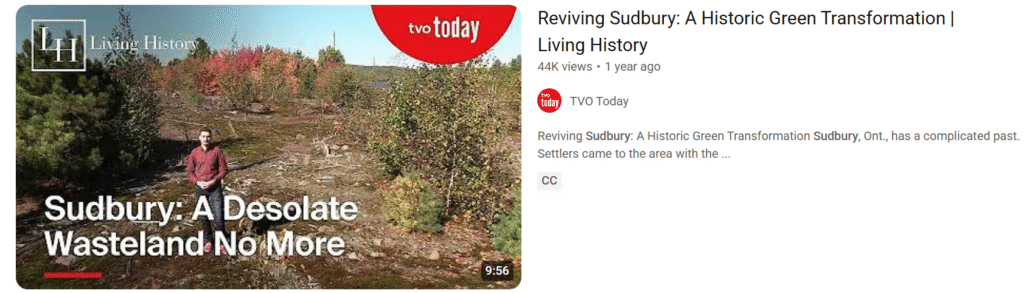
Source: https://www.youtube.com/watch?v=JU3iOzByOj8
Here is the learning objective I would have in mind for this video:
After several sessions examining this video, the transcript and the real life context, the student will (A) be more familiar with (i) the vocabulary used to discuss re-greening polluted areas (ii) the form, meaning and usage of selected grammatical structures and (B) will have increased their knowledge.